


🌬️ Topic 7 — Why Oxygen Is the Engine of Vinegar Fermentation The Science of Live Vinegar Series

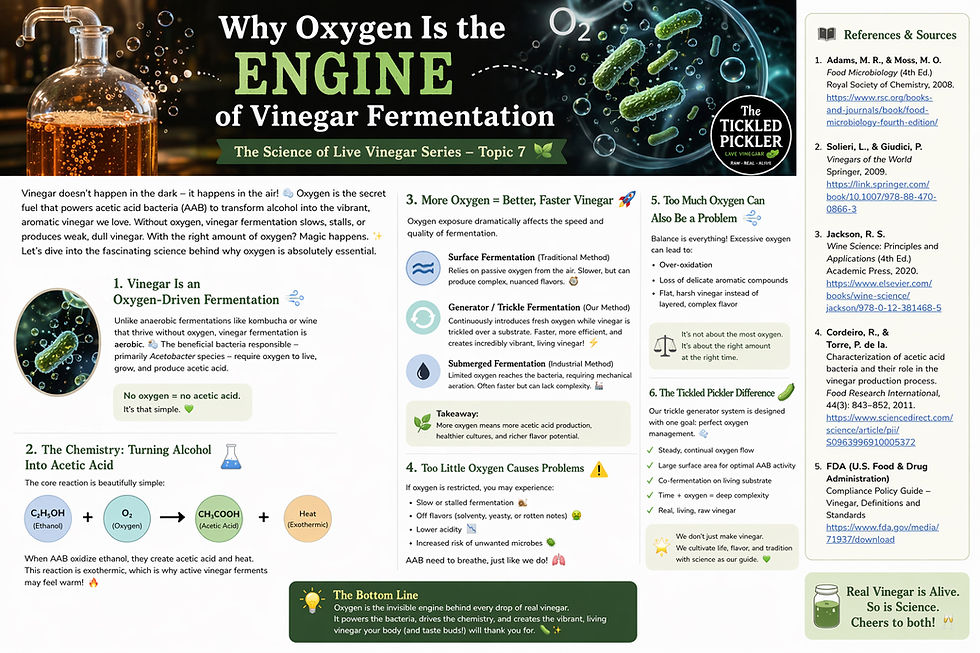
Vinegar doesn’t happen in the dark — it happens in the air. 🌬️
While most fermentation (like beer, wine, or kombucha) happens without oxygen, vinegar is completely different.
It depends on oxygen to exist.
Without it?
No transformation.
No acetic acid.
No vinegar.
Let’s break down the science behind why oxygen is the driving force behind every drop of real, living vinegar. 🧪✨
🦠 Vinegar Is an Oxygen-Driven Fermentation
Unlike anaerobic fermentation, vinegar production is an aerobic process, meaning it requires oxygen.
The key players are acetic acid bacteria (AAB) — primarily species in the Acetobacter genus — which need oxygen to survive and function.
These bacteria take alcohol (ethanol) and, with oxygen, convert it into acetic acid — the defining compound of vinegar.
👉 No oxygen = no acetic acid production
That’s not a preference — it’s a requirement.
⚗️ The Chemistry Behind the Magic
At its core, vinegar fermentation is a simple but powerful reaction:
Ethanol (alcohol) + Oxygen → Acetic Acid + Water
+ Heat 🔥
This process is oxidation, and it is exothermic, meaning it releases heat as it happens. That’s why active vinegar fermentations can sometimes feel slightly warm — the bacteria are literally generating energy as they work.
🚀 More Oxygen = Faster, Stronger Vinegar
Oxygen availability directly impacts fermentation speed and efficiency.
Different vinegar-making methods are essentially different ways of managing oxygen:
🏺 Surface Fermentation (Traditional)
* Relies on passive oxygen exposure
* Slower process
* Often produces complex, nuanced flavors
🌬️ Generator / Trickle Method (Modern Craft)
* Continuously introduces oxygen
* Liquid is circulated over a substrate
* Faster, more efficient conversion
* Maintains strong bacterial activity
🏭 Submerged Fermentation (Industrial)
* Oxygen is mechanically injected
* Extremely fast production
* Often prioritizes speed over complexity
👉 The takeaway:
Oxygen isn’t just helpful — it determines how vinegar develops.
⚠️ What Happens When Oxygen Is Limited
When oxygen is restricted, fermentation can run into problems:
❌ slow or stalled conversion
❌ incomplete alcohol oxidation
❌ off-flavors (yeasty, flat, or solvent-like)
❌ weaker final acidity
Acetic acid bacteria are highly active organisms — but only when they can “breathe.”
⚖️ Too Much Oxygen? That’s a Problem Too
Balance matters.
Excessive oxygen exposure can lead to:
⚠️ over-oxidation
⚠️ breakdown of desirable flavor compounds
⚠️ loss of aromatic complexity
In extreme cases, vinegar can become flat, harsh, or overly sharp instead of layered and vibrant.
🧠 The Craft Advantage: Controlled Oxygen
This is where craft production shines. ✨
The goal isn’t maximum oxygen —
it’s controlled oxygen exposure over time.
Well-managed systems allow:
✔️ steady bacterial activity
✔️ efficient alcohol conversion
✔️ preservation of delicate aromatics
✔️ development of complex flavor compounds
This balance is what separates living, artisanal vinegar from purely industrial production.
⭐ Final Takeaway
Oxygen is the invisible engine behind vinegar fermentation.
It powers the bacteria.
It drives the chemistry.
It shapes the flavor.
Without it, vinegar simply wouldn’t exist.
With the right amount?
You get something far more interesting than just acid — you get depth, character, and living flavor. ✨
📚 Scientific & Technical References
Adams, M. R., & Moss, M. O. Food Microbiology
Solieri, L., & Giudici, P. Vinegars of the World
Jackson, R. S. Wine Science: Principles and Applications
FAO. Fermented Fruits and Vegetables – A Global Perspective
U.S. National Library of Medicine — Acetic Acid Bacteria Overview
authored with assistance from ChatGPT


Comments