


🐣 Speckled Easter Eggs: The Science, The Style, The Pickler Twist

Updated: Apr 11
Let’s be honest—plain dyed Easter eggs are fine…
But we don’t do fine at The Tickled Pickler.
We do bold.
We do layered.
We do “wait… how did you DO that?”
This year, we’re bringing you a ridiculously simple trick that turns basic eggs into speckled, marbled masterpieces—using something you already have in your kitchen:
👉 Oil
🧪 What’s Actually Happening (The Real Science)
When you add oil to your dye bath, you’re introducing a nonpolar liquid into a polar (water-based) solution.
Water + dye = polar
Oil = nonpolar
Result = they don’t mix
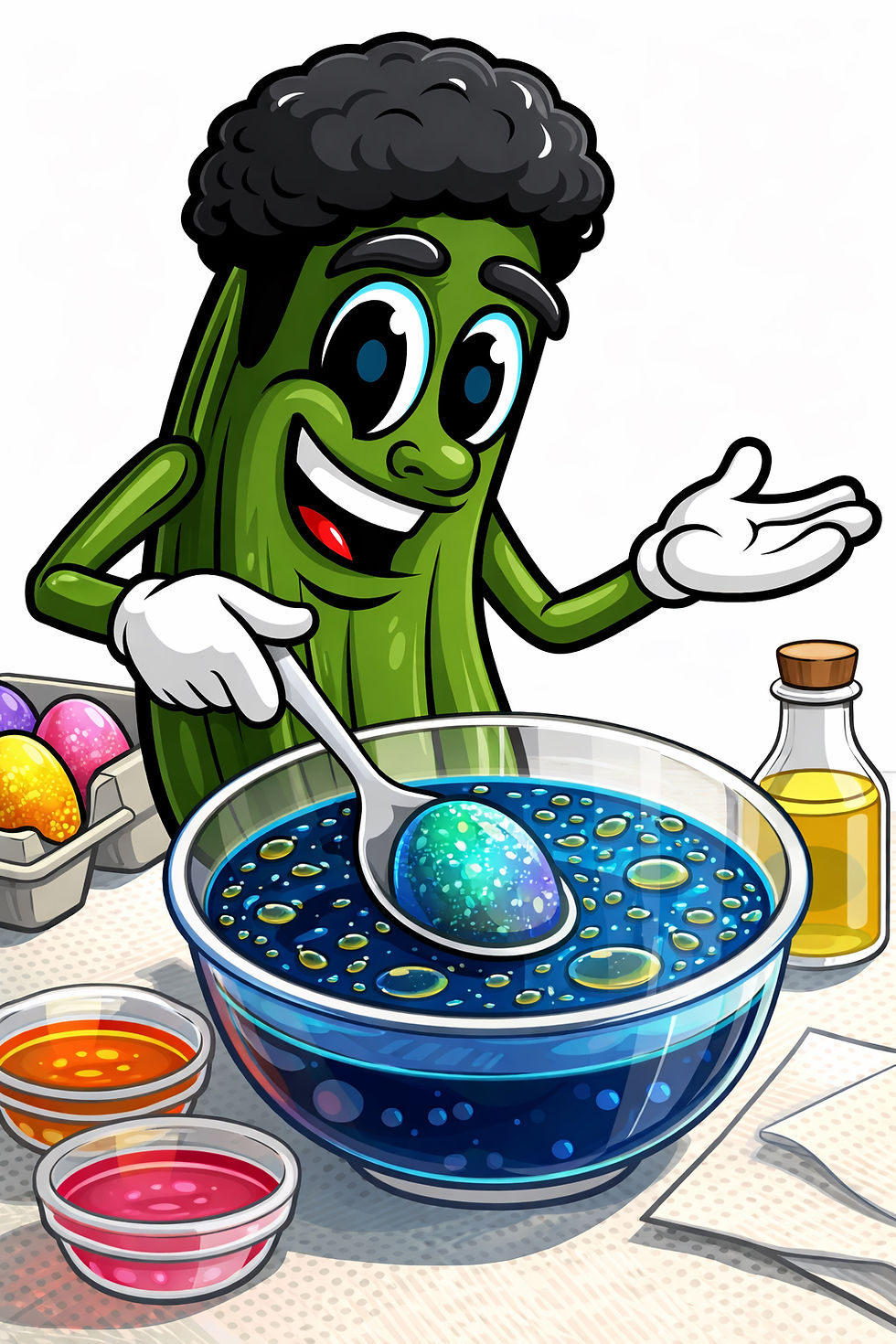
This creates tiny droplets of oil that sit on the surface of the egg, blocking dye from binding evenly.
That’s why you get:
Speckles
Marble streaks
Layered color breaks
This phenomenon is based on hydrophobic interactions and polarity—a fundamental concept in chemistry.
🎨 How to Create the Speckled Effect
You’ll need:
Hard-boiled eggs
Food coloring or egg dye kit
Water + vinegar (standard dye base)
A few drops of oil (vegetable or olive oil)
Paper towels
🥚 Step-by-Step:
1. Start with a base color
Dye your egg in your first color and let it dry completely.
2. Prep your speckle bath
Add a few drops of oil to your dye. Lightly stir—you want droplets, not a full mix.
3. Dip briefly
Quickly dip the egg into the oil-dye mixture.
4. Remove and wipe
Gently wipe the egg with a paper towel to remove excess oil.
5. Layer colors
Repeat with different colors for a bold, dimensional look.
🥒 The Pickler Perspective
At The Tickled Pickler, this is our playground.
We’re constantly working with: t
Liquid interactions
Surface chemistry
Fermentation reactions
And this? This is the same exact concept.
Because whether you’re:
Layering dye on an egg
Or building flavor in a live vinegar
👉 It all comes down to how liquids interact, repel, absorb, and transform.
That’s how we turn simple ingredients into something bold, complex, and unforgettable.
Same science. Different canvas.
🐰 Pro Tips for Next-Level Eggs
Use less oil than you think—you want droplets, not a film
Try contrasting colors (yellow → blue, pink → purple)
Let each layer fully dry before adding another
Dab instead of wiping for softer speckles
Spin the egg slightly in the dye for marbled streaks
🧼 Safety Tips (If You’re Eating Them!)
If you plan to eat your eggs (and you should 👀):
Keep eggs refrigerated
Don’t leave them out longer than 2 hours
Use food-safe dyes
🐣 Final Thought
This isn’t just egg dyeing.
It’s:
Chemistry
Creativity
Controlled chaos
And honestly… that’s exactly what we’re about.
At The Tickled Pickler, we take the same curiosity and apply it to everything we do—from live vinegars to DIY brines to bold, flavor-packed creations.
Because around here…
👉 We don’t do bland. We turn it GRAND. 😏🥒✨
📚 Sources:
Science Buddies – Hydrophobic vs. Hydrophilic
https://www.sciencebuddies.org/science-fair-projects/references/hydrophobic-hydrophilic
Khan Academy – Intermolecular Forces & Polarity
https://www.khanacademy.org/science/chemistry/intermolecular-forces-and-properties
📚 Technique Sources:
McCormick – How to Make Marbled Easter Eggs
https://www.mccormick.com/articles/mccormick/how-to-make-marbled-easter-eggs
Better Homes & Gardens – Marbled Easter Egg Tutorial https://www.bhg.com/holidays/easter/eggs/how-to-dye-easter-eggs/
📚 Safety Sources:
USDA Egg Products & Food Safety
https://www.usda.gov/media/blog/2016/03/21/eggs-citing-safety
American Egg Board – Eggcyclopedia (Handling Eggs)
authored with assistance from ChatGPT


Comments