


From Scraps to Squiggles: How a Slow Food Atlanta Grant Is Helping Us Build a Zero-Waste Business

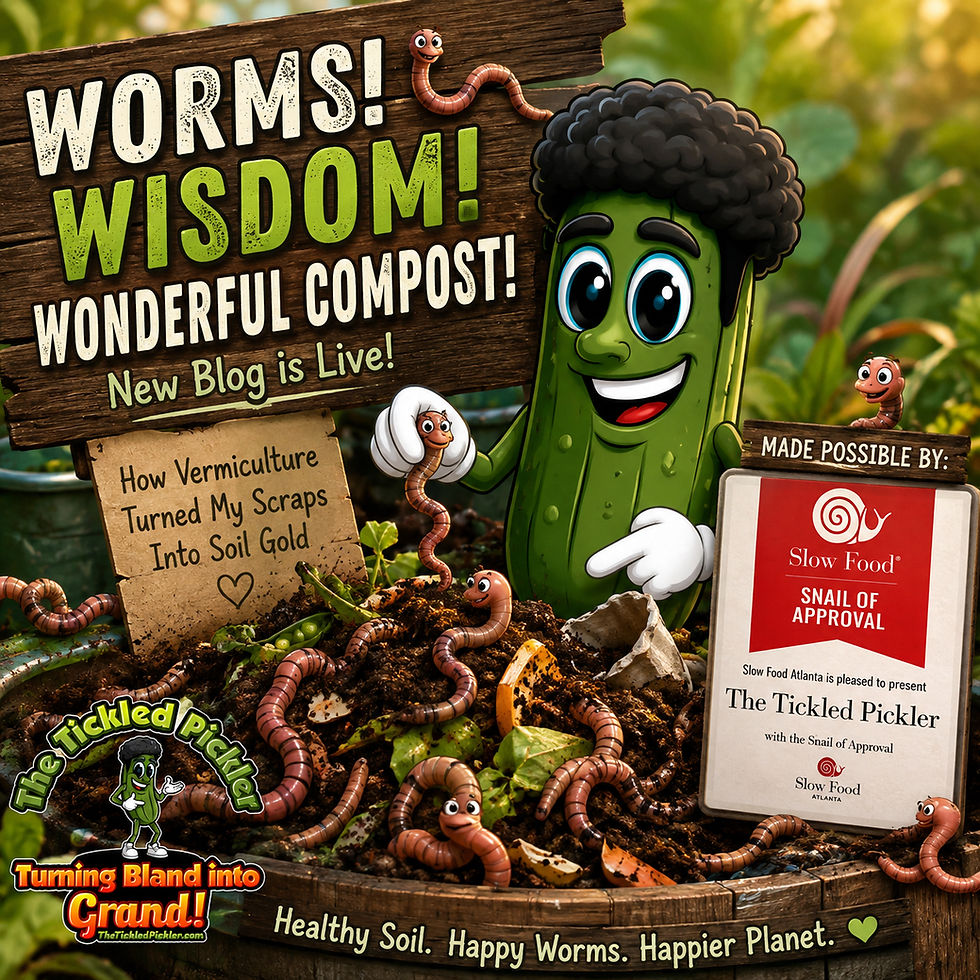
The Tickled Pickler is a proud recipient of Slow Food Atlanta's Good Food Grant, and we're using that support to do something specific: build the composting and vermiculture infrastructure that's turning us into a genuinely zero-waste business, one worm bin at a time. This isn't a side project — it's the plan the grant funded, and it's already up and running: multiple worm bins, a dedicated composter, and bins built right into our garden beds.
Here's what vermiculture actually is, how it works, and how we're using our grant to put it to work.
What Is Vermiculture, Exactly?
Vermiculture — also called vermicomposting or worm composting — uses composting worms (not the earthworms in your yard; a different species entirely) to break down food scraps into nutrient-rich compost called castings. According to the [USDA](https://www.usda.gov/about-usda/news/blog/worms-work-recycling-food-waste), vermicomposting turns food scraps into a soil amendment that can go straight into gardens, landscaping, and farms — and it matters because roughly a third of all available food goes uneaten through loss or waste. Composting keeps those scraps out of landfills, where buried food waste breaks down without oxygen and releases methane, a greenhouse gas far more potent than carbon dioxide.
For a food business that generates scraps daily — peels, husks, trim, ends — that's not an abstract statistic. It's exactly the waste stream vermiculture is built to solve.
How Vermiculture Works, Step by Step
Based on guidance from the [EPA](https://www.epa.gov/recycle/how-create-and-maintain-indoor-worm-composting-bin) and [USDA](https://www.usda.gov/about-usda/news/blog/worms-work-recycling-food-waste), here's the basic process, whether you're running one bin at home or several like we are:
1. Set up the bin. Worm bins need drainage holes near the bottom and ventilation holes near the top, both covered with fine screening so the worms stay in and excess liquid can drain out.
2. Build the bedding. Line the bin with damp shredded paper or dried leaves, mixed with a handful of soil, about three inches deep.
3. Add the worms. Red wigglers are the standard choice — not bait-shop worms or worms dug from the yard, which won't thrive in a bin. Let them settle into the bedding for about a day before feeding.
4. Feed on a schedule. Add vegetable and fruit scraps, coffee grounds, tea bags, and crushed eggshells. Skip meat, dairy, greasy foods, and citrus. Bury the scraps under the bedding rather than leaving them exposed — covered scraps break down faster and don't attract fruit flies.
5. Keep temperature and moisture in check. Worm bins do best between roughly 59-77°F, kept in shade if outdoors, with bedding that's moist but not soggy.
6. Harvest the castings. After about three to six months, finished vermicompost collects at the bottom of the bin. It doesn't need to cure — it can go straight onto garden beds or be stored for later use.
That's the process running in our own backyard right now, in bins tucked against the house and built directly into the garden beds. Scraps go in, castings come out, and the castings feed the soil where our garden ingredients grow.
Why We're Doing This: The Grant, and the Goal
Slow Food Atlanta's Good Food Grant is what got this system off the ground, and it's directly funding our path toward zero waste — not a vague sustainability gesture, but a specific operational goal: divert as much of our production waste as possible away from landfills and back into productive soil. The grant is what let us go from a single bin to a full composting and vermiculture setup, including bins integrated directly into our garden beds.
That matters because it closes a loop most small food businesses can't close: our scraps become our soil, and our soil grows the herbs, produce, and garden ingredients that go back into future batches. It's not compost for compost's sake — it's compost with a job, and it's how we're building The Tickled Pickler into a zero-waste operation, not just a small-batch one.
Try It Yourself
You don't need a grant to start small. A single worm bin, a pound of red wigglers, and a weekly habit of feeding scraps is enough to keep a noticeable amount of food waste out of the landfill. The [EPA's step-by-step guide](https://www.epa.gov/recycle/how-create-and-maintain-indoor-worm-composting-bin) and the [USDA's overview](https://www.usda.gov/about-usda/news/blog/worms-work-recycling-food-waste) are both solid places to start.
As for us — we'll keep feeding the worms, thanking Slow Food Atlanta, and turning bland into grand, one scrap at a time.
Sources
- U.S. EPA, "How to Create and Maintain an Indoor Worm Composting Bin": https://www.epa.gov/recycle/how-create-and-maintain-indoor-worm-composting-bin
- U.S. EPA, "Composting At Home": https://www.epa.gov/recycle/composting-home
- USDA, "Worms at Work: Recycling Food Waste" (Nina Bhattacharyya, USDA Office of Urban Agriculture and Innovative Production): https://www.usda.gov/about-usda/news/blog/worms-work-recycling-food-waste
authored with assistance from Claude.ai


Comments